Concrete driveways offer superior longevity (30-50 years) and higher weight capacity (8,000+ lbs) compared to asphalt (15-20 years, 6,000 lbs), though they command higher initial costs ($4-8 per sq ft vs. $2-5). While concrete provides extensive design options and requires less frequent maintenance, asphalt better handles cold climates and costs less upfront. Climate considerations, maintenance requirements, and aesthetic preferences greatly influence the ideal choice between these distinctive paving materials.
Expert Highlights
- Concrete driveways last significantly longer (30-50 years) than asphalt driveways (15-20 years), but cost roughly twice as much per square foot.
- Concrete offers superior design flexibility with stamping, staining, and scoring options, while asphalt provides limited aesthetic choices.
- Asphalt performs better in cold climates due to its flexibility, while concrete maintains better structural integrity in extreme heat.
- Concrete requires less frequent maintenance (every 2-3 years) compared to asphalt (every 1-2 years), resulting in lower long-term maintenance costs.
- Concrete can support heavier weights (over 8,000 lbs) than asphalt (up to 6,000 lbs), making it better for large vehicles.
Cost Comparison: Concrete vs. Asphalt Installation

When evaluating driveway materials, the initial installation cost represents one of the most important factors in the decision-making process between concrete and asphalt.
Concrete driveways typically cost between $4 to $8 per square foot for basic installation, while premium finishes and decorative options can push costs to $15 per square foot or higher. These figures include necessary site preparation, forms, reinforcement materials, and professional labor costs.
Asphalt driveways, by comparison, generally range from $2 to $5 per square foot for standard installation. The lower cost stems from simpler installation procedures and less expensive raw materials.
However, property owners should note that regional factors, such as climate conditions and local material availability, can greatly impact final pricing for both options. This makes it essential to obtain multiple local quotes for accurate cost comparison.
While the upfront costs may be higher, concrete’s durability can provide excellent value with a lifespan of up to 30 years when properly maintained.
Durability and Lifespan Expectations

While initial costs represent a significant investment consideration, the long-term value of a driveway material ultimately depends on its durability and expected lifespan. Concrete driveways typically demonstrate superior longevity compared to asphalt alternatives, with proper maintenance extending their functionality for decades.
| Feature | Concrete | Asphalt |
|---|---|---|
| Average Lifespan | 30-50 years | 15-20 years |
| Weight Capacity | 8,000+ lbs | 6,000 lbs |
| Weather Resistance | Excellent | Good |
| Maintenance Interval | 2-3 years | 1-2 years |
Concrete’s durability stems from its dense molecular structure and compressive strength, enabling it to withstand heavy vehicle loads and extreme temperature variations. The material’s resistance to cracking, scaling, and surface wear makes it particularly suitable for regions experiencing severe weather conditions, though proper installation and seasonal maintenance remain essential for maximizing its service life. For optimal performance, routine maintenance inspections should include cleaning and resealing every 2-3 years to preserve the surface integrity.
Climate and Weather Impact on Both Materials

Various climate conditions and weather patterns exert distinct effects on concrete and asphalt surfaces, influencing their structural integrity and long-term performance characteristics.
Concrete demonstrates superior resistance to heat, maintaining structural stability even during extreme temperature spikes, while asphalt can soften and deform in temperatures exceeding 95°F.
In extreme heat, concrete maintains its structural integrity while asphalt surfaces become vulnerable to softening and deformation above 95°F.
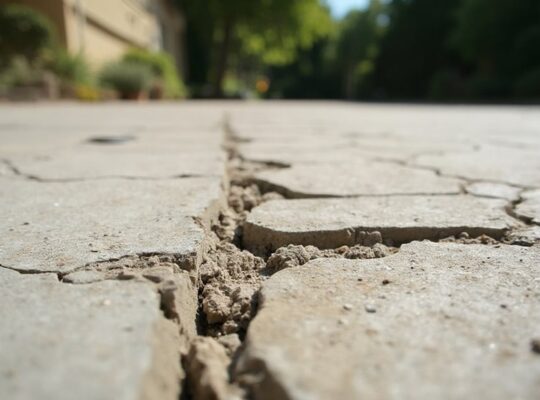
In cold climates, concrete’s primary vulnerability emerges through freeze-thaw cycles, which can cause cracking and surface deterioration if proper air entrainment isn’t present in the mixture.
Asphalt typically handles cold temperatures more effectively, displaying greater flexibility that allows it to expand and contract without significant damage.
Salt exposure during winter maintenance presents challenges for both materials, though concrete proves particularly susceptible to scaling and spalling when deicing chemicals are applied frequently, necessitating proper sealing and maintenance protocols.
As a Twin Cities contractor, Legacy General Services emphasizes proper concrete installation techniques to maximize durability in Minnesota’s challenging climate conditions.
Maintenance Requirements and Repair Costs

The maintenance requirements and associated repair costs for concrete driveways represent significant factors in their long-term value proposition.
Regular upkeep helps extend the lifespan of concrete surfaces while preventing costly repairs and maintaining aesthetic appeal.
Property owners should be aware of these essential maintenance considerations:
- Annual cleaning and sealing, which costs between $0.50 and $2.50 per square foot
- Crack filling and patching, typically required every 3-5 years, averaging $300-800 per repair
- Professional pressure washing every 2-3 years at $100-300 per service
- Periodic joint sealing maintenance, necessary every 4-6 years, costing $200-400
While concrete requires less frequent maintenance than asphalt, addressing issues promptly prevents deterioration and more extensive damage.
Ultimately, preserving the investment in the driveway’s structural integrity and appearance is crucial.
Design Options and Curb Appeal

Beyond maintenance considerations, concrete driveways offer homeowners extensive design possibilities that greatly impact property aesthetics and market value.
Through techniques like stamping, staining, and scoring, concrete can replicate the appearance of brick, stone, or tile while maintaining superior durability. Color options range from traditional gray to warm earth tones and bold architectural hues.
Decorative finishes include exposed aggregate, which reveals natural stone patterns, and brushed textures that provide both visual interest and slip resistance.
Border treatments and geometric patterns can be incorporated to complement a home’s architectural style. Professional contractors can create custom designs using specialized tools and techniques, including saw-cutting intricate patterns or embedding decorative inlays.
These design elements transform a utilitarian driveway into an aesthetic focal point that enhances overall curb appeal and property value.
Frequently Asked Questions
How Long Should I Wait Before Parking on a New Concrete Driveway?
Most homeowners should wait at least seven days before parking on a new concrete driveway, though heavy vehicles may require up to 28 days to guarantee proper curing and strength.
Can Road Salt Damage My Concrete or Asphalt Driveway?
Road salt can damage both concrete and asphalt driveways by causing surface deterioration and cracks. Smart homeowners protect their investment by using calcium chloride or sand-based alternatives instead.
Will Oil Stains Permanently Damage My Driveway?
Oil stains can permanently discolor driveways if left untreated. Most homeowners can prevent lasting damage by quickly absorbing fresh spills with cat litter and cleaning with a degreaser solution.
Are Permits Required for Installing a Concrete or Asphalt Driveway?
Most communities require permits for new driveway installations or major modifications. Homeowners should check with their local municipality’s building department and HOA for specific requirements before starting work.
Can Tree Roots Grow Under and Crack My Driveway?
Tree roots can indeed damage driveways by growing underneath and exerting upward pressure. Many homeowners face this common issue, which leads to cracks and uneven surfaces requiring repairs.
Expert Final Thougts
When weighing concrete against asphalt driveways, homeowners must consider their specific circumstances, climate conditions, and long-term objectives. While concrete offers superior longevity and design versatility at a higher upfront cost, asphalt provides more economical installation and easier repairs. The choice ultimately depends on factors including local weather patterns, budget constraints, and aesthetic preferences, with both materials presenting viable options when properly installed and maintained according to manufacturer specifications.